
Reviewed · DOLPHIN WATCHING
Dolphin Sanctuary Kayak Tour Adelaide
Adelaide’s Dolphin Sanctuary is best seen at water level, where your kayak slips through mangrove channels and open estuary water. The big prize is a wild dolphin surfacing near your boat, but the setting also delivers birdlife, fish, old wrecks, and quiet corners that make the paddle worthwhile even when the dolphins stay out of sight.
I like the small-group format, the included kayak and life jacket, and the patient instruction for first-time paddlers. I also like that guides such as Alex, Paddy, Callie, Fiona, Hannah, Lewis, and Marc combine safety advice with information about the sanctuary instead of simply leading you from point A to point B.
The main caution is simple: dolphins are not guaranteed. They are free-ranging animals, and some departures see several dolphins close to the kayaks while others see none. You should book this as a nature kayak tour in a dolphin sanctuary, not as a guaranteed dolphin encounter.
Key points
- Wildlife sightings are possible but never promised: Dolphins, birds, and fish may appear, but the sanctuary is open to animals moving wherever they choose.
- Mangrove channels are the tour’s dependable highlight: The slow paddle through tree-lined water offers shelter, scenery, and a close look at this unusual habitat.
- The pace suits beginners: No previous kayaking experience is required, and guides provide a short lesson and safety briefing before departure.
- Shipwrecks may be part of the route: Conditions, tides, and the group’s ability determine whether the kayaks reach them.
- Families with older children can join: Children aged 10 to 15 must share a kayak with a parent or adult and must be able to paddle.
- Plan for a little effort and a few insects: Moderate fitness is recommended, shoulder problems may make the tour unsuitable, and insect repellent is a smart addition.
What the Adelaide Dolphin Sanctuary tour is really about
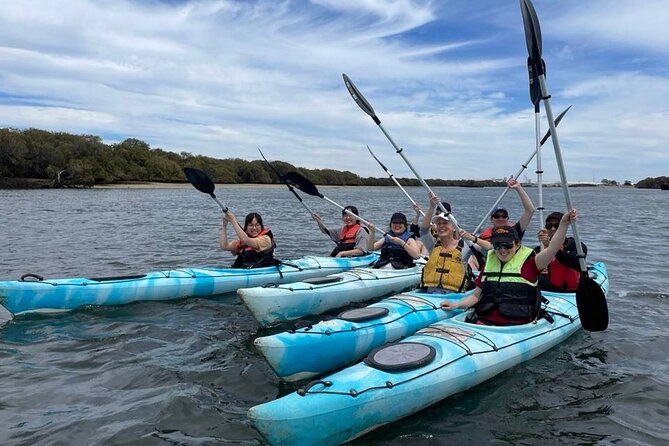
The name may set your expectations too high. This is a three-hour kayak outing inside the Adelaide Dolphin Sanctuary, where dolphins sometimes swim near the boats, not a controlled wildlife show with a scheduled animal appearance.
That distinction matters. Some outings have seen dolphins right away, including mothers with calves, several animals moving among the kayaks, or playful dolphins surfacing close by. Other departures have found only birds, fish, mangroves, and wrecks. Both results are normal for a wild sanctuary.
I like the honesty of treating the dolphin sighting as a bonus. The more useful question is whether you would still enjoy paddling through mangrove creeks and estuary water if the dolphins do not appear. If the answer is yes, this tour has solid appeal. If a dolphin sighting is the only reason you are booking, the cost may feel harder to justify.
The tour costs $56.66 per person and lasts about three hours. That is reasonable value if you want equipment, instruction, a guide, and a focused outdoor activity rather than simply hiring a kayak and setting off alone. The value drops if you expect a guaranteed wildlife encounter or a long expedition covering every part of the sanctuary.
More Dolphin Watching in Adelaide
- Adelaide: Dolphin Sanctuary Eco Kayaking Tour
★ 4.5 · 560 reviews - Adelaide: 4-Hour Swimming with Dolphins Experience
★ 4.7 · 439 reviews - Port Adelaide: Dolphin and Ships Graveyard Cruise
★ 4.5 · 375 reviews
Arriving at Garden Island and getting ready
You meet at Angas Inlet Boat Club, Lot 204 Garden Island Road, Garden Island SA 5015. You need to arrive 15 minutes before the start time. That early arrival is not a minor detail, since the group must be fitted with life jackets, given paddles, offered waterproof storage, and taken through basic safety instructions.
The usual setup includes a short paddling tutorial and a safety chat. Kayaking gear and life jackets are included, and a waterproof bag is available for valuables. You should still bring drinking water. One useful practical tip is to use insect repellent before heading into the mangroves, especially after rain, when mosquitoes may be more noticeable.
The maximum group size is 16 people. That is small enough for direct help, though the experience can feel slower when several people are new to kayaking or need extra assistance. A departure with mixed abilities may cover less ground than a stronger, faster group.
There have been occasions when weather and wind affected how the day operated. Strong conditions can change the route, prevent access to the shipwrecks, or lead to a cancellation. If poor weather cancels the activity, you are offered another date or a full refund.
The first paddle: calm water, clear instructions
Once everyone is ready, the group moves onto the water at a gentle pace. You do not need previous kayaking experience, but you should expect to paddle rather than simply sit and watch. Moderate fitness is recommended, and the tour is not a good choice if you have shoulder problems.
The guides are central to the experience. Alex is often praised for friendly explanations and humor, while Paddy is noted for knowing when to talk and when to leave the group in quiet water with the wildlife. Callie has helped less confident paddlers through tricky sections, and Fiona, Hannah, Lewis, and Marc have also led outings with a mix of safety advice and natural history.
That matters because a guide can make a first paddle feel manageable. The best support here is practical: helping you keep up, explaining how to steer, and watching the group while pointing out wildlife. You should not expect a formal classroom lesson or an intense technical kayaking course. The instruction is aimed at getting you comfortable enough to enjoy the sanctuary.
The pace is generally slow to moderate. This works well for families and beginners, but stronger paddlers may find it restrained. The group must stay together, and the least confident paddlers influence how far you go.
Through the mangroves, where the tour earns its keep
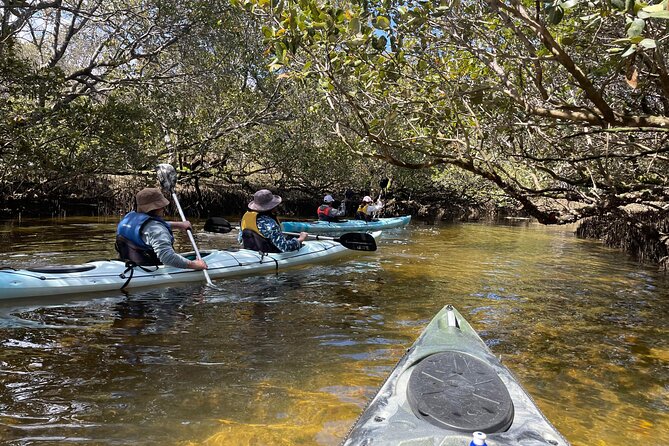
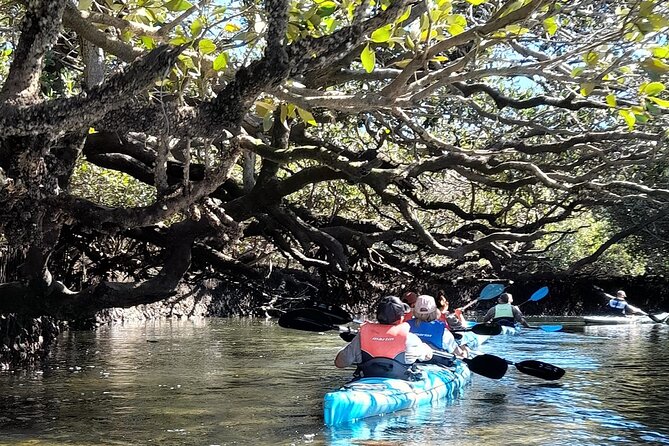
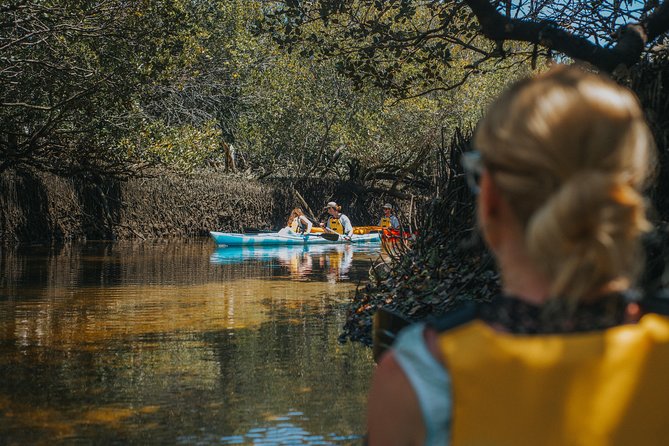
The mangrove sections are the most reliable part of the outing. You paddle through narrow, tree-lined waterways where the scenery feels more enclosed and personal than the open estuary. Roots, branches, mudflats, and shallow channels give you a closer look at a habitat that is easy to miss from land.
This is also where the tour feels less like a standard city activity. You are not passing famous buildings or ticking off a list of sights. Instead, you are moving quietly through a working natural environment, with the sound of paddles and water doing much of the work.
Keep an eye out for birds and fish as well as dolphins. Several outings have included birdlife and fish even when the main attraction stayed away. The guides can explain the animals and their habitat, helping you understand why the mangroves matter rather than treating them as background scenery.
The narrow channels can be enjoyable for a first-time paddler because they give the route a clear shape. They can also be a little awkward if you are still learning to turn. This is where patient guidance helps, particularly for children or adults who have never shared a kayak before.
More Wildlife Parks in Adelaide
- Adelaide Dolphin Sanctuary and Ships Graveyard Kayak Tour
★ 5.0 · 275 reviews - Dolphin Sanctuary and Ships Graveyard Kayak Tour
★ 4.7 · 143 reviews - Adelaide Zoo: General Admission Tickets
★ 4.5 · 80 reviews - Adelaide: Dolphin Sanctuary Mangroves Kayak Tour
★ 4.2 · 54 reviews
Looking for dolphins without chasing them
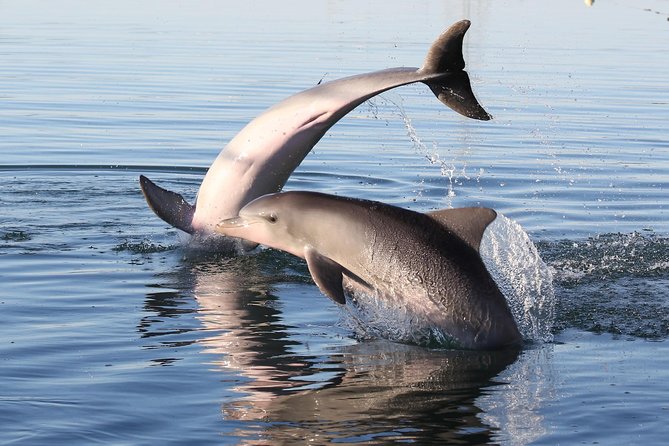
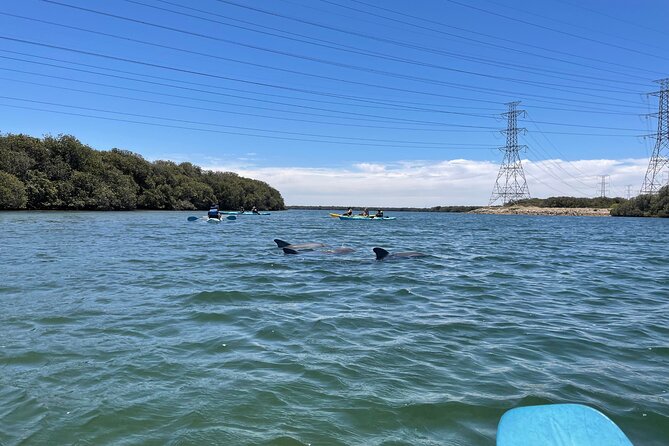
Dolphins are the emotional high point when they appear. You might see one surfacing in the distance, several animals passing near the kayaks, or a mother and calf moving through the water. Some outings have had dolphins appear before the paddlers were fully on the water, while others have seen them repeatedly during the session.
The right approach is to watch and wait. These are wild dolphins, and they can move to another part of the sanctuary or remain below the surface. The guides respect that freedom rather than promising a close encounter or trying to force one.
This is also why a guide’s attitude matters. A good leader keeps the group interested in the birds, fish, mangroves, and wrecks when the dolphins are absent. You may paddle for much of the session without seeing the animals named in the tour title. That can be disappointing, but it is not a sign that the sanctuary has failed.
If you want the best chance of a sighting, conditions will matter, but the available information does not provide reliable odds or a guaranteed departure pattern. You should choose a day when you would be content with the kayaking itself.
Shipwrecks, tides, and route changes
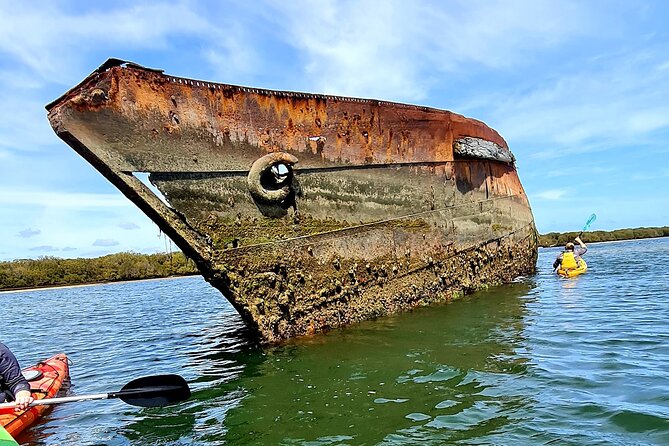
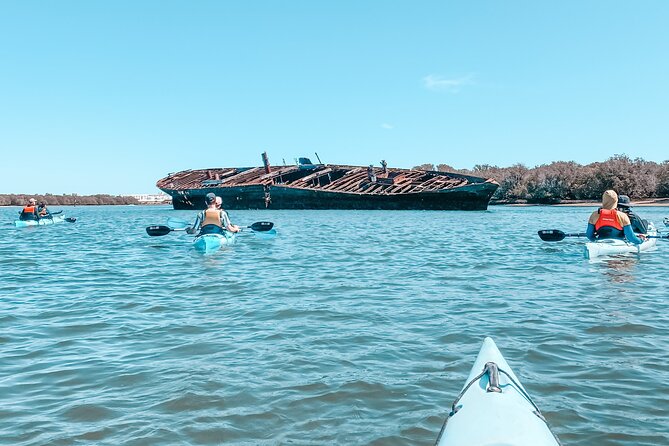
The shipwrecks add a pleasing sense of discovery to the route and can make good photo subjects. They give the open-water sections a clear point of interest, especially when the dolphins are not around.
You may not reach them on every departure. Strong tides, wind, weather, and the group’s paddling ability can affect the route. Guides may also decide that conditions are not right for a particular section. That is sensible, even if you had hoped to see more wrecks.
Some paddlers have reached the wrecks while also seeing dolphins and moving through the mangroves. Others have stayed in the estuary and tree-lined channels because the water was choppy or the tide was running strongly. I would treat the wrecks as a possible extra, not a fixed promise.
This is one reason the tour’s slow pace can be useful. It allows the guide to keep an eye on the group and adjust the route rather than pushing everyone into water beyond their ability.
Family suitability and physical effort
The tour works well for families with older children. Children aged 10 to 15 must share a kayak with a parent or adult, and they must be able to paddle. Children under 10 are not permitted.
A shared kayak can be a pleasant family activity, though you and your child will need to coordinate your strokes. The guide team can help with confidence and technique, but you should be ready for active participation from both people.
Older adults may also find the kayaking comfortable. The main issue is not speed. It is the repeated shoulder and torso movement involved in paddling, getting in and out, and handling the kayak. Anyone with shoulder problems should choose another activity or seek medical advice before booking.
You do not need an athlete’s fitness level, but you should be able to paddle for much of the three-hour session. Expect a slow to moderate outing, not a passive boat cruise.
What to bring for a more comfortable morning
The operator supplies the main kayaking equipment, life jackets, paddles, and a waterproof bag for valuables. You should bring water in a bottle, insect repellent, and clothing suitable for outdoor conditions.
The mangroves can attract mosquitoes, with wet weather sometimes making them worse. Repellent is one of the simplest ways to improve the outing. Keep valuable items limited even with a dry bag, and use the waterproof storage provided for anything you do bring.
Weather can change the feel of the tour. Calm conditions make the open water easier and improve your chance of enjoying a relaxed paddle. Wind and chop may make the session harder, and they can shorten or alter the route. The operator can cancel for poor weather, with a new date or full refund offered.
Your mobile ticket should be ready, and arriving early is essential. The meeting point is also the finishing point, so you return to Angas Inlet Boat Club rather than ending at another location.
Who will get the best value from the $56.66 price
I think the price is fair for someone who wants a guided outdoor activity with equipment included. You are paying for more than boat hire: the safety setup, naturalist-style commentary, group supervision, waterproof storage, and the chance to explore a habitat that is difficult to experience from shore.
The price feels strongest when your group is new to kayaking or when you value the guide’s help. Families can share a memorable activity without needing to own or transport equipment. Beginners also avoid the uncertainty of choosing a route alone.
The calculation changes if you are an experienced paddler who wants to travel quickly or independently. A mixed-ability group may move slowly, and you may not reach the shipwrecks. The price also becomes harder to defend if you are booking only for a guaranteed dolphin sighting, since no such guarantee is possible.
The 95 percent recommendation rate and 4.7 rating from 355 reviews suggest broad satisfaction, but the important lesson is not the number. The best experiences combine good weather, a comfortable group, and dolphins that happen to be nearby. A less fortunate departure can still be pleasant, but it may feel like a scenic paddle rather than a wildlife encounter.
Should you book the Dolphin Sanctuary Kayak Tour?
Book it if you want a relaxed, guided paddle through Adelaide’s mangroves and you would welcome dolphins without depending on them. It suits beginners, families with children aged 10 and over, and anyone who enjoys birds, fish, shipwrecks, and quiet water.
Think twice if you dislike group pacing, have shoulder trouble, or would consider the day a failure without dolphins. You should also accept that tides and weather may change the route.
For the best mindset, picture a three-hour nature outing with a possible dolphin encounter. If dolphins appear, the moment can be extraordinary. If they do not, you still have a guided way into the sanctuary’s mangrove channels, with equipment supplied and help close at hand.
FAQ
Where does the Dolphin Sanctuary Kayak Tour start and finish?
The tour starts at Angas Inlet Boat Club, Lot 204 Garden Island Road, Garden Island SA 5015. It ends back at the same meeting point.
How long does the kayaking tour last?
The tour lasts approximately three hours.
Do I need previous kayaking experience?
No. Previous experience is not required. You receive a short tutorial and safety briefing, but moderate physical fitness is recommended.
Are dolphins guaranteed on the tour?
No. The dolphins are wild and can move freely around the sanctuary, so sightings are not guaranteed.
Can children join the kayaking tour?
Children aged 10 to 15 may join if they share a kayak with a parent or adult and can paddle. Children under 10 are not permitted.
What happens if bad weather cancels the tour?
If poor weather causes a cancellation, you are offered a different date or a full refund. Free cancellation is also available if you cancel at least 24 hours before the start time.
More dolphin cruises from Adelaide
- Adelaide: 4-Hour Guaranteed Wild Dolphin Watching Cruise
★ 4.8 · 349 reviews - Moreton Island: Dolphin & Tangalooma Wrecks Snorkel Cruise
★ 4.5 · 1,039 reviews - Port Stephens: Dolphin Discovery Cruise
★ 4.4 · 926 reviews - Mandurah: Dolphin and Views Cruise
★ 4.6 · 920 reviews
More animal encounters near Adelaide
- Adelaide: Dolphin Sanctuary Single or Double Kayak Rental
★ 4.1 · 51 reviews - All Inclusive Blue Mountain,Scenic World,Lunch,Koalas,ferry
★ 5.0 · 7,832 reviews - Blue Mountains Small-Group Tour from Sydney with Scenic World,Sydney Zoo & Ferry
★ 5.0 · 3,709 reviews - Blue Mountains Adventure: Scenic World, Zoo & Koala Photo
★ 4.7 · 2,062 reviews
Just added in Adelaide
- Adelaide: Sunset Rooftop Tour at Adelaide Oval★ 4.7 · 55 reviews
- Adelaide: River Torrens Popeye Devonshire Tea Cruise★ 4.7 · 207 reviews
- Adelaide: Surfing Lesson at Middleton Beach with Equipment★ 4.7 · 28 reviews
- Adelaide to Melbourne: 3-Day Ultimate Overland Journey★ 4.9 · 50 reviews
- Adelaide Zoo: General Admission Tickets★ 4.5 · 80 reviews
- Adelaide City Highlights Half-Day Tour, Mt Lofty & Hahndorf★ 3.8 · 25 reviews
- Adelaide: Rooftop Climbing Experience of the Adelaide Oval★ 4.8 · 326 reviews
- Best of Adelaide- City Highlights (Half-Day Tour)★ 4.5 · 21 reviews
Dolphin Watching, compared.

Jervis Bay Day Trip with Dolphins, Roos & Beach Time
Read our review →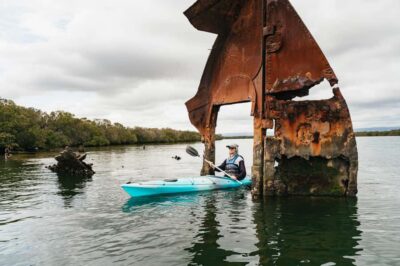
Browse the lists this tour appears in