
Reviewed · SKYDIVING
Cairns: Tandem Skydive Experience over Reef & Rainforest
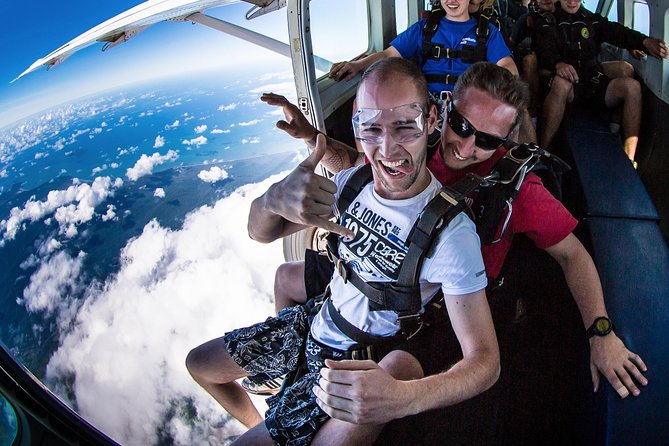
Cairns gives you a rare chance to see the Great Barrier Reef and tropical rainforest from 15,000 feet before dropping into freefall with a trained instructor. No past experience is needed, and the whole outing takes about three hours from the Cairns meeting point.
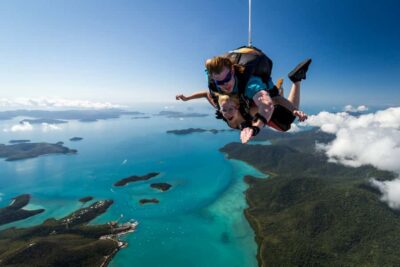
I like the calm, well-organized approach and the fact that instructors such as Sam, Brant, Victor, and Phil have earned praise for clear instructions. I also like the peaceful change after freefall, when the parachute opens and you can take in the reef, islands, Coral Sea, and Atherton Tablelands from above.
The main thing to understand is that the reef is not always directly below you. You may see it best from the aircraft and parachute, while the landing area is on farmland near the rainforest and coast. Also budget an extra A$179 for the optional photo and video package.
Key points before you book
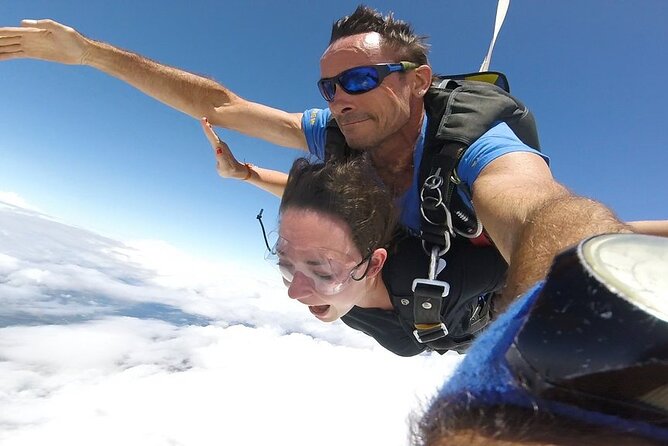
- 15,000-foot departure: You can fall for roughly the length of a song before the parachute opens, although exact conditions and jump height can vary.
- Reef views are weather dependent: Fitzroy Island, Green Island, the Coral Sea, and the reef may appear in the distance rather than directly below the aircraft.
- A true first-timer activity: Your instructor handles the equipment and jump procedure, while you follow simple body-position and landing instructions.
- The ground portion is short: The main lesson lasts about 15 minutes, but waiting, aircraft timing, and weather can make the total outing longer.
- Media costs nearly as much as the jump: Photos and video are not included and cost A$179 per person at the drop zone.
- Weight and age rules matter: A surcharge applies from 94 kilograms, the maximum stated weight is 110 kilograms on application, and anyone aged 16 or 17 needs approval and a parent or guardian.
What the three-hour Cairns jump is really like
You start at 11 Spence Street in Cairns City. The activity returns to this meeting point, and the location is near public transport. The advertised duration is about three hours, but you should leave room in your day for weather delays, aircraft scheduling, and the time needed to organize several jumpers.
The first formal step is a safety briefing and lesson of about 15 minutes. This covers the main body position, what to do as you leave the aircraft, how to respond once the parachute opens, and how to prepare for landing. You are then fitted with the required equipment and attached to your instructor.
That last part matters. You are not managing the parachute, checking the harness, or deciding when to open it. The qualified instructor controls those jobs. Your part is to listen, keep your body in the requested position, and follow directions during takeoff, freefall, and landing.
Several instructors have been praised for doing this well. Sam helped one nervous jumper stay calm from aircraft departure through landing. Brant reassured an anxious participant with his extensive experience, while Victor was noted for precise instructions. Those details give you a useful picture of the human side of the jump: the instructor is not just a safety attachment, but the person who makes the whole event feel manageable.
Other jumps booked around Cairns:
- Cairns: Tandem Skydive Experience
★ 4.9 · 282 reviews - Cairns: Tandem Skydive
★ 4.8 · 192 reviews - Airlie Beach: Tandem Skydive over the Whitsundays
★ 4.8 · 726 reviews
The flight up to 15,000 feet
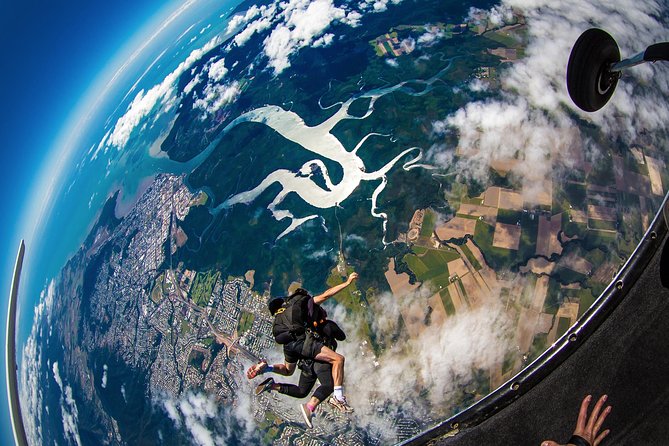
The aircraft climb is part of the sightseeing. As Cairns drops away, you may see the Atherton Tablelands, the Coral Sea, rainforest areas, and the reef and islands around the coast. Fitzroy Island and Green Island are among the named points you may see from above.
The view depends heavily on clouds, light, and the exact aircraft route. Do not book this expecting a close-up aerial tour of coral formations. The reef can sit in the distance, and several descriptions make clear that the best views may come during the climb or parachute descent rather than in the first seconds after leaving the plane.
That distinction is important. The title suggests a jump directly over reef and rainforest, but the landing zone is described as a sugar-field area. You may see rainforest on the way down and reef toward the coast, yet you will not land on an island or beside the sea.
For many people, that is still a fine trade. You get both the changing view and the physical thrill of a high-altitude freefall. If your main goal is to examine the reef, a boat or scenic flight will give you a more focused look. If your main goal is the sensation of leaving an aircraft, the coastal scenery adds a memorable setting.
Freefall first, calm descent afterward
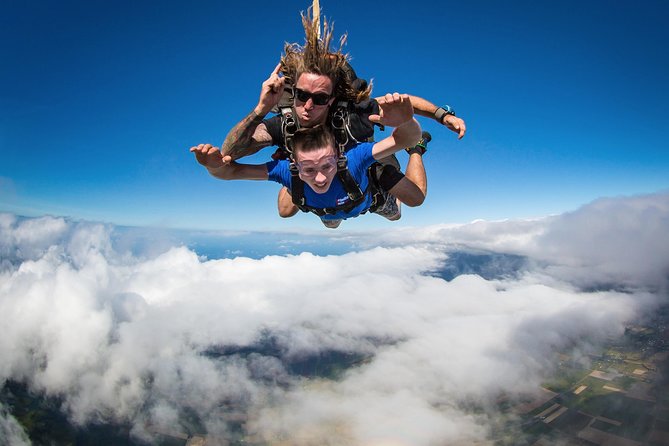
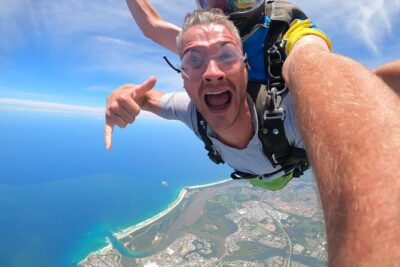
The aircraft door opens, your legs move out, and the instructor guides the exit. The first seconds can feel too fast to process. The wind is loud, your ears may pop, and your attention narrows to your body position and the air rushing past you.
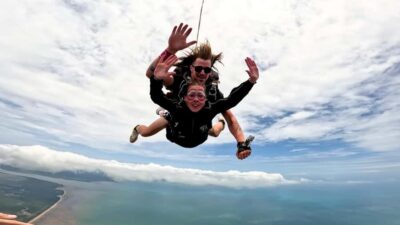
The freefall is the most intense part of the outing. It is also the part most often singled out as the highlight. You have little time to worry once you are out of the aircraft, and the instructor remains attached behind you throughout the fall.
When the parachute opens, the mood changes sharply. The noise drops, the descent slows, and you have time to look around. This is when the islands, rainforest, coast, and farmland are easier to appreciate. You may also pass through a cloud, as one jumper did, creating a brief change in light and visibility.
The views are not guaranteed to be clear. Rain and cloud can delay the activity, and they can also limit what you see. The operator may change your jump time, so do not schedule a tight connection or another fixed activity immediately afterward.
Landing on the farmland
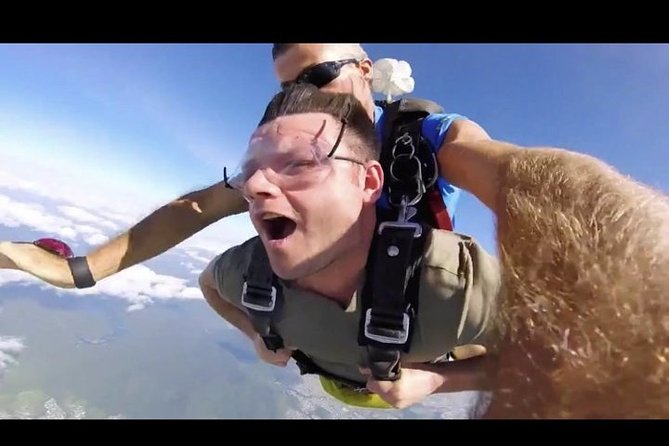
The final approach is less dramatic than the freefall but still needs attention. You are instructed to lift your legs for landing while the instructor takes care of the approach. The instructor lands on their feet, and you move forward once you reach the ground.
This is one reason the tandem format works for a first attempt. You do not need to master a solo landing technique. You do need enough flexibility to bend your neck back, position your body correctly, and lift your legs when instructed.
A moderate level of fitness is required. One 54-year-old participant with a troublesome knee managed the activity, but that should not be taken as medical clearance for everyone. Parachuting carries real risks, including possible problems with the parachute, aircraft, weather, health, or landing. You take part at your own risk, so disclose relevant health concerns and follow the operator’s requirements.
Wear practical clothing and trainers. You must empty your pockets and remove necklaces or other loose items. Personal cameras are not permitted during the jump because they could fall away. Protective gear is offered, and face visors are used during the early part of the descent before you can remove them under the parachute.
Same base, a different sort of day:
- Great Barrier Reef Snorkeling and Diving Cruise from Cairns
★ 4.5 · 3,714 reviews - From Cairns: Great Barrier Reef Cruise by Premium Catamaran
★ 4.9 · 3,567 reviews - From Cairns: Self-Guided Kuranda Trip with Train and Skyrail
★ 4.6 · 3,392 reviews - Cairns: Outer Edges of The Great Barrier Reef Scenic Flight
★ 4.9 · 2,912 reviews
The photo and video decision
The basic price is $250.32 per person. It includes the qualified instructor, safety equipment, Australian Parachuting Levy and Administration Fee, and a commemorative certificate with your name. Food and drinks are not included.
The optional photo and video package costs A$179 per person at the drop zone. That is a large extra charge, close to the cost of the jump itself, so decide before you arrive. You cannot use your own GoPro, but the instructor may record the event with an attached camera.
The package can include a large set of still photos and a professionally edited video. One description refers to around 80 images and a four to five minute film with music. If you want proof of the exit, freefall, parachute descent, and landing, the package has real value. If you are happy to keep the memory without buying media, skip it and protect your budget.
The certificate is included, but it is a small keepsake rather than a substitute for photos. If this is a once-only event for you, think about the media decision when you book, not while you are still processing the jump.
Who will get the most from this activity
This suits you if you want a major adrenaline experience but do not want to learn solo parachuting. The instructor manages the technical work, making the activity possible for a first-timer who meets the age, weight, and fitness rules.
It also fits couples or friends who want a shared story. One couple in their 60s completed the jump, while repeat jumpers returned because the freefall remained the main attraction. You do not need to be young or highly athletic, but you do need to be comfortable with the physical demands and the stated risks.
It is less suitable if your priority is a detailed reef viewing trip. The reef may be far away, obscured by cloud, or visible mainly during the aircraft ride. Choose a reef cruise or scenic flight if coral and marine life are your focus.
You should also think twice about booking this on a day packed with other plans. Weather can move the schedule, and one pickup problem was reported, even though the jump itself went well. Keep the day flexible and confirm transport arrangements before heading out.
Cost, timing, and practical value
At $250.32, the main price covers more than the thrill itself. You are paying for aircraft time, qualified staff, safety equipment, required administration, and a certificate. Compared with arranging a course or a solo jump, the tandem format gives you a simple entry point with much less preparation.
The extra costs change the calculation. Add A$179 for photos and video if you want them, plus any food, drinks, or personal transport costs. A surcharge applies to participants weighing 94 kilograms or more, and the maximum stated weight is 110 kilograms on application.
The minimum age is 16, subject to approval. Anyone under 18 must have a parent or guardian present. A moderate fitness level is expected, and the operator may require you to register with the Australian Parachute club before the activity. One account also mentions optional personal insurance at an additional cost, so ask for current details before booking.
The tour has a maximum of 20 participants. That does not mean you will jump in a group, since you are attached to your own instructor, but it does mean the operation can involve waiting. Patience helps, especially when clouds or rain affect the aircraft.
Cancellation is free up to 24 hours before the start time. Cancellations or changes inside that window are not refunded. If bad weather or insufficient numbers cause the operator to cancel, you can choose another date or receive a full refund.
My bottom line: book it for the freefall
I would choose this activity for the sensation of freefall, the reassurance of a professional instructor, and the chance to see Cairns from an unusual height. The strongest part is not a perfectly framed reef panorama. It is the sequence of climbing above the coast, stepping out, racing through the air, then floating quietly back toward the fields.
Book it if you are ready for a serious thrill and can keep your schedule flexible. Set realistic expectations about the scenery, bring the right clothes, and decide in advance if A$179 for media fits your budget.
Skip it if you want a close, reliable view of coral or if weather uncertainty will cause stress. For everyone else, this is a well-supported first tandem jump in a memorable part of Queensland, with the freefall providing the payoff.
FAQ
Where does the activity start?
It starts at 11 Spence Street, Cairns City, Queensland 4870, Australia.
Where does the activity finish?
It finishes back at the meeting point in Cairns.
How long does the experience take?
The stated duration is approximately three hours.
How high is the jump?
The jump can take place from up to 15,000 feet, or 4,572 meters.
Do I need previous parachuting experience?
No. The activity is designed for first-timers and includes a tandem instructor.
What does the price include?
The price includes a qualified jumper, safety equipment, the Australian Parachuting Levy and Administration Fee, and a commemorative skydive certificate.
Are photos and video included?
No. Photo and video packages are optional and cost A$179 per person at the drop zone.
Can I bring my own camera?
No. Personal cameras are not permitted during the jump. The instructor may record the experience with an attached camera.
Are there age and weight requirements?
The minimum age is 16 and requires approval. Anyone under 18 must be accompanied by a parent or guardian. A surcharge applies from 94 kilograms, and the maximum stated weight is 110 kilograms on application.
What happens if the weather is poor?
The activity requires suitable weather. If the operator cancels because of weather, you can choose another date or receive a full refund.
Just added in Cairns
- Ultimate Great Barrier Reef and Rainforest 45-minute Helicopter Tour★ 5.0 · 59 reviews
- Paronella Park and Millaa Millaa Falls Full-day Tour from Cairns★ 5.0 · 47 reviews
- Night Walk in Cairns Botanic Gardens – Let’s Go Buggin★ 5.0 · 153 reviews
- Small-Group Afternoon Cairns City Tour with Harbour Dinner Cruise★ 4.5 · 32 reviews
- Full Day Tour to Sunlover Cruises Moore Reef and Fitzroy Island★ 4.0 · 31 reviews
- Full-day Tour at the Atherton Tablelands with Food Tasting★ 5.0 · 30 reviews
- Cairns City Sights and Surrounds Tour★ 5.0 · 227 reviews
- Skyrail Rainforest Cableway Day Trip from Cairns★ 4.5 · 228 reviews
Skydiving, compared.
Tandem Skydiving Experience with Beach Landing
Read our review →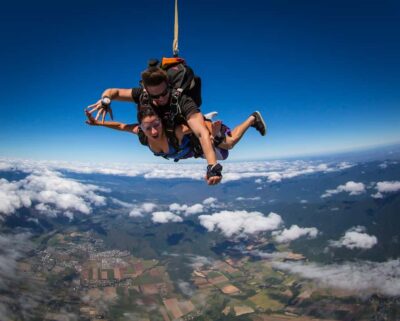
Airlie Beach Tandem Skydive Over the Whitsunday Islands
Read our review →
Browse the lists this tour appears in